
What Choice Do We Have?
1. Left and Right have had their day


This was intended to be a single essay on the relevance of our political discourse but (inevitably, perhaps) it began to grow into a more philosophical view and I realised it was going to be far too long a piece for a single sitting. While I sometimes enjoy lengthy essays that really get into the subject I also tend to feel a certain trepidation in embarking on such texts and occasionally bottle out!
You are therefore spared and I shall perhaps make this a two-parter and put out the sequel in due course.
What’s it all about (“Alfie”, for the Cilla & Dionne fans)
I had better establish from the start that I am writing from a European and Transatlantic perspective although the implications should have resonance far beyond this limited arena.
I have had a sense for some time that this terminology of Left and Right has become more and more irrelevant. That is, the focus on this duality has shifted to more immediate and different framings: other dualities, perhaps, like open democracy versus authoritarianism, national interests versus international cooperation or climate change believers versus climate change deniers. These pairings take on an even greater salience as we stand in the shadow of the very tangible clouds represented by the accumulation of capital by monopolies and cartels that impoverishes ever more of the population, the undeniable increase in catastrophic weather events and the increasing difficulty in maintaining water supply let alone meeting the increases demanded by industrial processes and data centres.
You would be forgiven if you thought this Left/Right labelling was a long established division that defined the political spectrum for ever. It does seem so when you enter and begin to immerse yourself into political discussion. It’s not that these distinctions have disappeared. History has a long reach and Left / Right descriptors will always be needed to refer to the issues of the period but that period is fading fast. The once accepted polarity is oddly reminiscent of when I went to a new school close to Manchester at the age of seven and on my first day was cornered in the playground by several lads wanting to know if I supported Manchester City or Manchester United. Having joined my brother in collecting football cards previously and randomly collected more ‘reds’ than ‘blues’ I instinctively answered “Manchester United” which in those parts in the mid 1960’s was known as the ‘right answer’! The Red/Blue choice was a red-hot issue at the time and for decades afterward but now feels dated in a radically different context in which the once ‘invincible’ club has lost its shine and performance in the hands of venture capitalists.
It is reminiscent because allegiances to political parties and football clubs have a very similar basis. The Manchester Derby position was a classic dualistic framing of choices. There was the odd renegade at the school who supported Everton but they were treated like court jesters. Any other football club was not even entertained. The two party political system also trades on this false dualism and minor parties are seen as an aberration or serving such small interests as to be unimportant. It is false partly because there has always been an establishment approach that has been adopted by all parties. The details of this approach have evolved over time but the world view of the ruling classes has always been central to governments of any colour. While we refer to our political system as a democracy and point to our institutions and practices as evidence the real power lies somewhere behind the curtain of our democratic structure. If authoritarianism can be analogous to Henry Ford offering you any colour as long as it’s black and then democracy as practised in the West is a choice between a black or white car as long as it’s a Ford.


The similarities go beyond this dualism in which, having set up the illusionary binary of ‘this one’ or ‘that one’, each provokes a tribal allegiance that is as much to do with opposition to the other as with the prowess of their own camp. ‘You’re either for us or against us and woe betide you if you’re against us’ is the implicit (and sometimes, explicit) message. There is of course a touch of the playground in politics here with its lack of nuance, blinkered framing and jockeying for position for the winner’s cup which earns you the right to mercilessly mock your adversaries. This constant Derby Day approach to parliamentary work with its jeering and paper waving, point-scoring and posturing is more a Comedia Del Arte than a serious attempt to solve the real problems that people are experiencing. In fact the stylised performance associated with that dramatic tradition is really a structural part of parliamentary life and it is hard not to conclude that its performative and distracting qualities are deliberately encouraged to create the illusion of debate while pandering to the prejudices of each sides supporters. In addition, the first past the post voting system (which is named after the sport of kings) itself helps maintain the binary nature of political choice making it virtually impossible for a third - let alone a fourth - party to gain a majority.
Some History (leading to why it is no longer relevant)
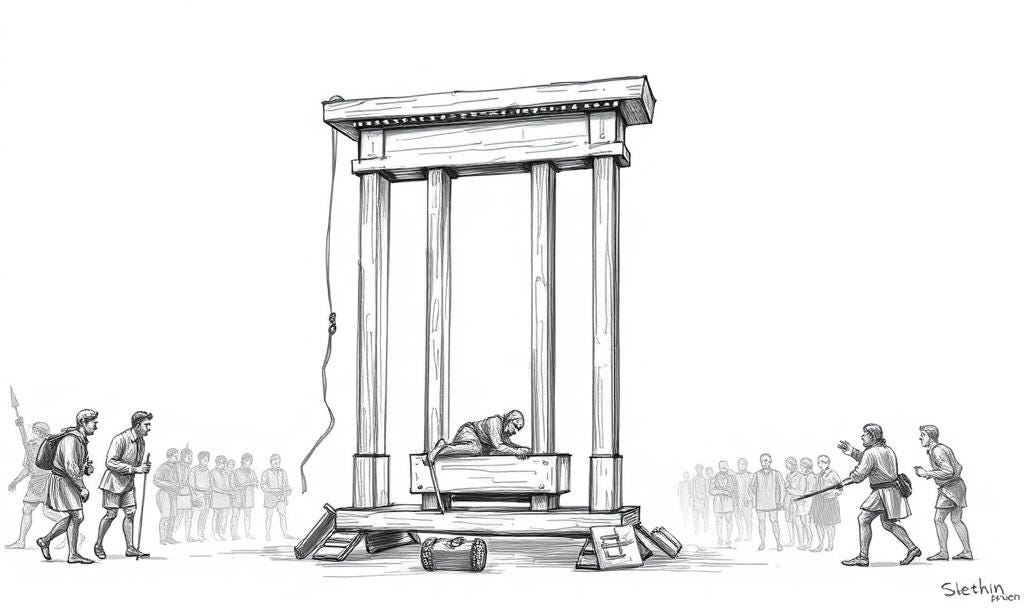
The Left and The Right have their origins in pre-revolutionary France where, in a debate on the absolute right of the Monarch to rule, those who agreed sat on the King’s right hand side and those with more democratic leanings sat on his left. This mirrored a debate in Britain in which the Tories supported the Monarch’s absolute right to rule and the Whigs sought to give parliament some power in the arrangement. The Whigs later came to advocate for parliamentary supremacy and were in government for much of the 17th and 18th centuries. This, and the later expansion of the franchise in Britain were very much influenced by the French Revolution and the fear of something similar happening here.
The terms (Left and Right) waxed and waned after this period and were revived in the 1920’s with the rise of the Bolsheviks but mainly to describe that side of the divide. The McCarthy witch hunts saw no duality here, just the threat to control. The subsequent rise of the Labour Party and the explosion of social freedom in the 1960’s revived the terms in a way that more closely reflects our use of them to this day. Whereas the terms in the preceding centuries had delineated this dipole as primarily a political structural debate in the mid to late 20th Century this moved to a social and economic difference, the Monarch having been effectively neutered as any real force in the governing of the country.
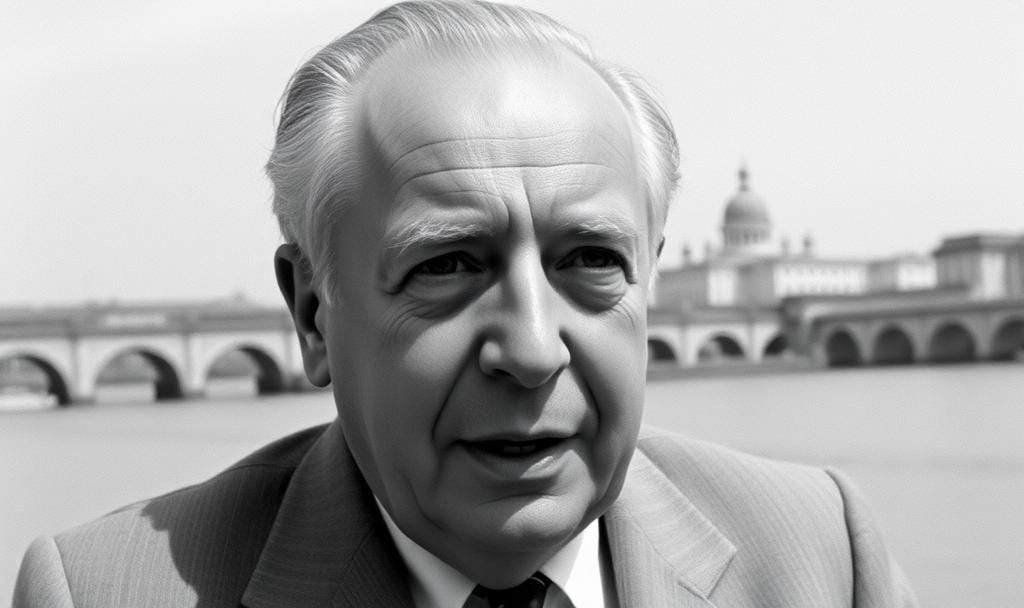
As a result, the Left came to be defined in terms of the organisation of labour, provision of public services, public ownership of the utilities and social security and the Right as the guardians of our institutions, promoters of free trade and private ownership. Immigration, as ever crossed the boundary amongst political supporters but the Conservative Party was more openly supportive of what we know today as The Great Replacement Theory. The staunch unionist Enoch Powell’s Rivers of Blood speech was exceptional in its explicitness but was in truth only saying the quiet part out loud and drew some support from elements of the Left. One example of the ruling class’s influence on both parties.
It’s worth noting that while the Right has always given the appearance of a pretty homogenous grouping that only differentiated itself from the extreme of Fascism the Left paraded itself as quite a rainbow of opinion from those who supported Communism to those who wanted to tweak the status quo in favour of greater social and economic equality rather than entertain any wholesale change. The proclivity of the Left to openly fragment along numerous lines of dogmatism has effectively kept it in opposition for much of the last hundred years with only administrations who offered more conservative appeal managing to gain power. In the 20th century the shadow of communism had replaced the shadow of the French Revolution but instead of leading to concessions to more socially focussed demands it had the effect of preserving the conservative status quo.
The reason that all this is no longer relevant is because of what has taken place in more recent years….
Modern Times
In the last 10 to 15 years there has been something of a shift. The economic paradigm that started to be implemented with Reagan and Thatcher took a couple of decades or so to develop and reveal itself as the hegemonic preference of all major parties and any others that had any serious pretensions to power - a major example of the power of the ruling class over so-called democratic institutions.

In this new field of play Conservatives are no longer the guardians of our institutions - quite the opposite. They are intent on reducing them to pawns in the game of power and that includes the very institution by which they gained power in the first place. The role of parliaments that had seemed so immutable and (for its time) democratic in our post-monarchical societies is under threat from the very people who espoused the sanctity of our democratic institutions not a couple of decades ago. The only thing they seem to want to conserve now is the economic advantage of large corporations and the politicians’ ability to profit from it.
The so-called Left has, in this time, largely disappeared, being relegated to the opposition benches in the scramble for power that plays only by the rules of neoliberalism. Such is its stranglehold that the brief rise of Jeremy Corbyn was effectively neutralised in spite of the fact that he garnered what would now be deemed as a winning number of votes.
This episode prefigured the changes I am describing and for many was the first experience of the naked power of the media and the transparent machinations of those that owned it - the (relatively) new ruling class. It is perhaps debatable whether the current Labour government’s lurch to more traditional Conservative territory is by choice (a misguided attempt to capture Reform votes) or has been the price of media support and corporate funding. It is in any case an abdication of their duty to address the immediate, mid term and long term issues facing this country and a betrayal of their membership that they have disastrously taken for granted.
Where are we now?
There used to be a general acceptance that there were people making much more money than you but it still left enough to get by on (and, for many, some besides for holidays and luxuries) but this is now a palpable fiction. The confluence of the threats and realities of climate change, degraded public services and the inability of young people to aspire to as good a life as their parents - which for some means not having enough to pay for rent, food and other essentials even while working 40 + hours a week - has pulled the veil away from the denizens of power and exposed the occupants as the cyphers of greed they have become or, to some extent, have always been.
The poor are no longer a small minority that can be left to the ministrations of charity while we congratulate ourselves as being in the large majority of those doing ok. In this country, those earning below what the Joseph Rowntree Foundation have set as the minimum necessary to get by is almost 36% of the population and the next 30% are paddling furiously to avoid dropping back in to that designation. With the resulting concentration of wealth at the very top decile of the population you can see that it is no longer a question of which bus will get us to our destination. Socialism and other variants of what has been known as The Left together with Conservative values that promote clear historical and recent failures are no longer an ideological choice.
The stark reality is that the constructs of the last century and in fact many centuries before have disintegrated and nobody in their right minds would want to reinstate any version that has previously existed. In the face of some sort of existential collapse surely there is only one way in which this ends well or at least well enough to ensure our survival as a species.
A future?
This way involves an approach which you might choose to describe as left wing: Being concerned for and prepared to participate in a society that supports everyone and particularly those who are in need. A system that funds essential services, work that is truly a choice and contributes to a larger society. Universal Basic Income, maybe - political change that many on the left have always dreamed of, you might think.
But politics as we know it - this age old device of control once epitomised by the autocracy of monarchs and now by the autocracy of monopolists - is dying. If it weren’t to die it would kill us. If it were resurrected it would be more of the same. It’s time to hospice modernity, as Vanessa de Oliveira describes it. Beyond the burial of this bloated corpse, is a chance to reset our priorities. A chance to value our ‘humanness’. The recognition that everyone should have enough not just to exist but to make something of their lives is no longer a political idea but an existential necessity. This means getting in touch with who we really are. Such a stance requires us to engage with the world around us, to feel the kinship of others whether they agree with us or not on the details of the way forward; to not just feel wonder at the natural world around us but to feel a part of it and feel the pain of it as if it were one of our own limbs that had been cut off; to understand and accept the cycle of life and death and that we are no more exempt from it than the leaves on a tree.
What do we call this approach? I don’t want to give it a name. Once named it is liable to dissection and constriction which would kill the life put under the microscope. It is a recognition that this viewpoint is reality without the blinkers of an acquisitive mindset, the shedding of the mechanistic world view and the re-acquaintance with the idea of our unity with the rest of creation that is alive, unpredictable and infinitely differentiated. It is both a fundamental truth and a path to a life that we can pass down to the generations to come in the knowledge that it will keep them safe and support the web of life they will need in order to pass it on for as long as this solar system can support life.
If I had to name it, I would choose to call it Love, not because it leaves a nice feeling in me for a bit but because that word carries a universe of possibilities without denying any and refuses any neat definition. What it does imply at its core is a life-affirming relationship with everyone and everything around us and the possibility of an endless growth of us as a participating species in the never-ending creation of life that is the Earth’s biosphere.

How we populate this path with systems and practices is something to be worked out and there are quite a few who are doing just that. But there is no garden of eden to reclaim. The planet will take centuries to stabilise and we will need to learn to live with violent weather conditions that will no doubt continue for the foreseeable future. We will need to accept that changing climatic conditions will favour some existing forms of life and extinguish others. Trying to preserve the world we knew and loved must give way to work that preserves the conditions for life now and in the foreseeable future. What we decide not to do is as important as what we decide to do. We can help but we can’t control. We can sow the seeds but there is never any certainty as to the outcome. We will need to embrace uncertainty and the practice of believing in an outcome that will be advantageous to us without knowing exactly what it is in advance.
That’s called Trust - a vanishing concept and one of a number of carriages that this runaway train has uncoupled and left stationary on the tracks.
Neither Love nor Trust can simply be re-hitched to a locomotive heading in a better direction. It will take a lot of work to rebuild the role of both in communities up and down the country, needing involvement, transparency and evidence of benign intent, not to mention a willingness to admit mistakes and change course as appropriate.
These things should not be decided by great thinkers whether they be philosophers or politicians but by the population at large. Ideology and Derby Day partisanship should play no part (in my view) but give way to common experience, pragmatism and shared values. Destructive narratives encouraged by those seeking power would wither away in a more locally based participatory structure in which we know each other and where Trust is more easily developed. A shared interest in the viability of a community is likely to mean the issue is not whether but how do we keep everyone safe and build a thriving community. The choices flow from there.
Hi Richard,
Thanks for this comprehensive part 1 of your thoughts. They definitely resonate with me.
Do you know about the international Draw the Line event? I like it because it addresses environmental, social and geopolitical issues. Here's a link: https://drawtheline.world/canada?r=CA&d=BC&lang=en